

It’s difficult to know where to start, because like you, we are overwhelmed and outraged by the daily deluge of anti-migrant news and hostile policies. While the UK faces multiple crises, from housing and spiralling cost of living to rising inequality – issues that require urgent political action and leadership, the government is choosing to scapegoat people seeking safety – branding them as our worst enemies.
So this month, we’re having to dig extra deep to find glimmers of hope.
In this issue, we will touch on the latest news and proposals to amend the asylum system, debunk the fictive link between immigration and crime, share more about our forthcoming event on 11th December – something to get excited about! – and lots more. A huge thank you goes out to volunteers who have contributed to this issue – you know who you are.
In these dark times, we really need you to show us some love:
🧡 Join us and share this newsletter with friends and family. Help us build a movement!
🪩 Get your ticket(s) for Connections in Sound.
🪧 Get a poster to display in your window.
📲 Follow our latest updates on Bluesky,Instagram and Facebook.
👋 Get in touch: [email protected] – we love hearing from you.
In solidarity,
Anne
Connections in Sound

…. it’s only THREE weeks away!
We love celebrating migrant communities, and on 11th December, we will be doing just that. Ahead of International Migrants Day, we are inviting you all to come on a magical journey across cultures, with music spanning different genres and continents.
Connections in Sound is a collaboration with London-based alternative electronic trio, Zelt, with kind support from independent, global music label Mais Um.
We have a stellar line up: ✨ Leensaa Getachew (Ethiopia) – Oromo songwriter and vocalist.
✨ Jana Saleh (Lebanon) – Electronic producer, composer, sound artist and DJ.
✨Zelt (Turkey/UK) – London-based Anglo-Turkish alternative/electronic/folk trio.
✨ Nkomba (Malawi/UK) – Contemporary mix of Malawian folk and African roots.
✨ With DJ set: Lewis Robinson (UK) – founder, Mais Um Discos Label
📣 Event Details:
📆 Thursday 11th December 2025
⏰ Doors open at 6.30 pm. Event from 7.00 pm to 11.00 pm.
📍 Walthamstow Trades Hall
🎫 Tickets £15 / concessions £5 can be purchased here.
Hurry, tickets are selling fast!
WFMA update
Over the last year, WFMA has continued, undeterred, to provide support to a growing number of people seeking safety. We are working with an incredible team of staff and volunteers to deliver free immigration and welfare advice in increasingly challenging times.
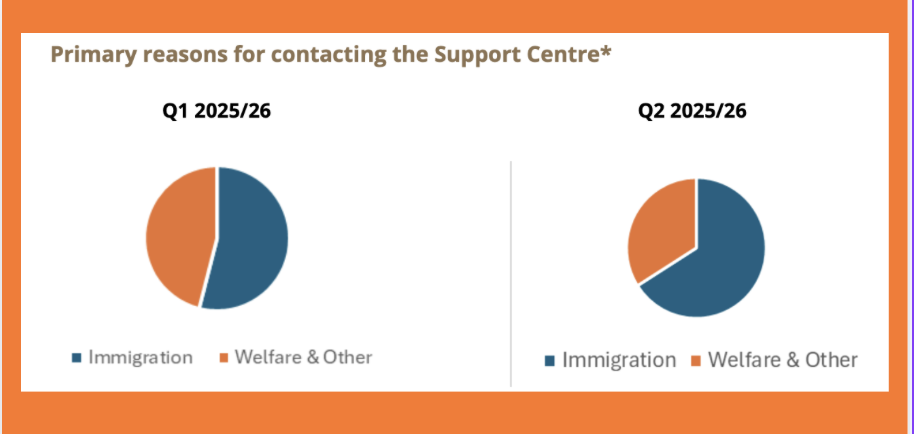
The chart shows a shift over recent weeks in the primary reason for people visiting the drop in. More people are coming to us for immigration advice. Many are expressing deep concerns at the current changes and looming insecurity.
People are particularly worried when they find out that there is no ‘fee waivers’ available for Indefinite Leave to Remain (ILR) applications, and for many this is a huge barrier. It pushes them further away from settlement, despite meeting all other requirements. With no fee-waiver available for ILR, the current cost of £3,029 is entirely out of reach for many low-income families. As a result, they face repeated periods of leave, ongoing insecurity, and the very real possibility that they may never be able to save enough to secure settlement. This creates a profound and unnecessary barrier on their pathway to citizenship.
Order your poster today!
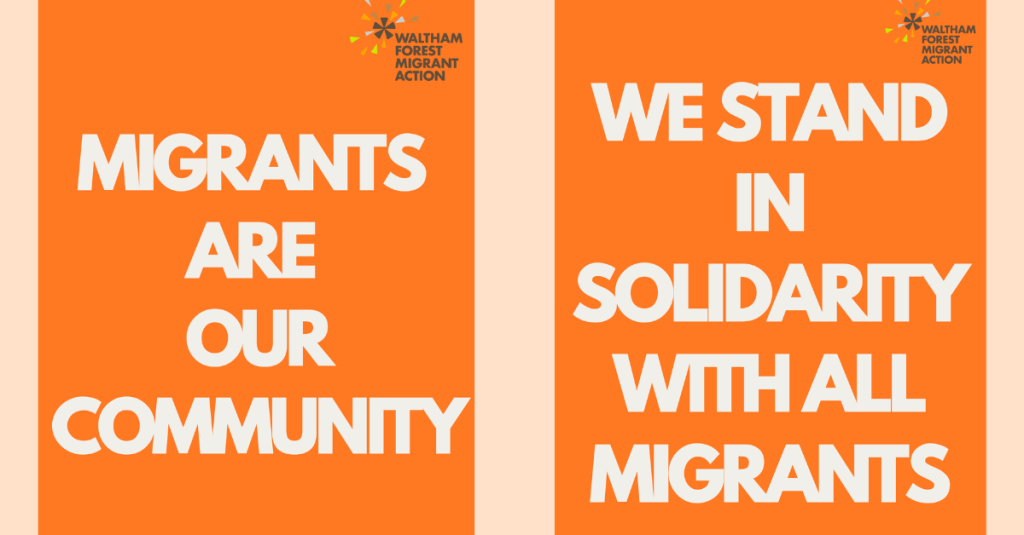
Like us, many of you have expressed dismay at the aggressive political tactics that are targeting people seeking safety. At this time, it is particularly crucial for our community to show solidarity with migrants. One of the ways you can do this is by displaying a poster at your window.
Posters will be available at our event stall on 11th December – so you can pick one up there.
If you can’t make the event, you can order one or request the pdf for home printing by emailing [email protected], stating your preference.
Posters are free, but donations gratefully received.
Thank you for joining the screening

Earlier this month, we worked with Stories and Supper and the William Morris Gallery to host a screening of a beautiful, very moving film – My Name is Lawand. If you missed it, you can catch it on the BFI player. Thank you to everyone who joined us.
Policy Update
Shabana Mahmood tearing communities apart
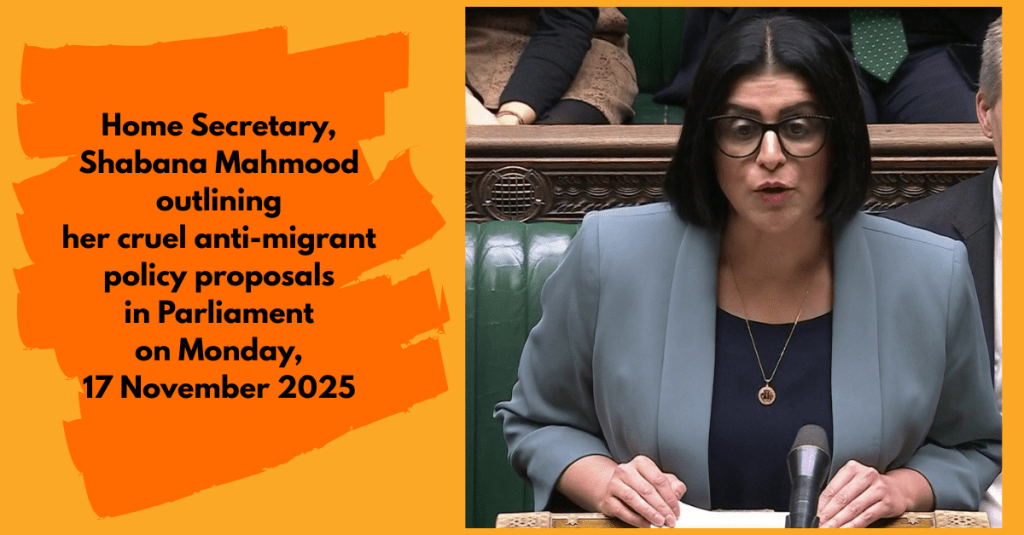
After touring TV news programmes on Sunday, Home Secretary, Shabana Mahmood presented her version of the hostile environment – ‘Restore Order and Control’ – in Parliament on Monday. The policy paper outlines a number of proposed changes that are as frightening as they are inhumane and counter-productive. They show complete disregard for people seeking safety – people who have fled terrible situations – wars, persecution, climate catastrophe – taken enormous risks, lost everything and are likely be experiencing severe trauma. Worryingly, these policy proposals emulate some of the most extreme rightwing and far-right narratives that dominate public discourse in the UK today.
This is a summary of the key measures:
🔻 Changes to refugee status
- Refugees are currently granted five years of guaranteed protection before they can apply for permanent status – i.e. Indefinite Leave to Remain (ILR). This could be replaced with a 20 year wait.
- Further, Leave to Remain will only be granted on a temporary basis – two and a half years at a time, with a requirement to reapply at the end of each period.
- Refugee status could be revoked if their home country is judged to be “safe.”
- In order to be eligible for ILR, refugees will have to demonstrate their “contribution” to society.
- “Automatic” right to refugee family reunion will be axed – it is already suspended.
🔻 Removals from the UK for people who do not have status in the UK – this may include deportation of families, including children. It also means an increase in raids and detentions. There have been 9,072 deportations between January and June 2025!
🔻 Changes to asylum support
- The government is proposing to replace their statutory duty to provide accommodation and essential living support to people seeking asylum who are, or are likely to become, destitute, such as housing and a weekly allowance, with a ‘discretionary power to offer support’.
- People seeking asylum are not allowed to work until their asylum claim has been processed. If they have been waiting 12 months, they can apply for permission to work, but only for a certain list of jobs requiring specific qualifications. The Home Office is now planning to remove support for people who have the right to work while their claim is being processed.
- And, wait for it – the government may seize jewellery and other valuables from them, as a form of ‘contribution’!
🔻 Reduced appeal rights
Many initial asylum decisions are poorly made and overturned on appeal – leading to a huge backlog of asylum appeals. The proposed ‘overhaul’ will introduce a new appeals body, to replace the existing Tribunal for immigration appeals and restrict people to one appeal. Such changes would undoubtedly make the system even more complicated and harder to navigate.
🔻 Changes to human rights protections
Everyone in the UK has human rights, which are recognised by the European Convention on Human Rights (ECHR). If removing someone from the UK might breach their human rights, this is sometimes treated as a reason not to remove them. Thegovernment is therefore proposing to “reinterpret” the rights in the ECHR – specifically Article 3, which protects people from torture and inhuman or degrading treatment, to “support the deportation of dangerous criminals”, and Article 8, which guarantees the right to family and private life, to make it more restrictive.
🔻 New legal and safe route to the UK
There are currently no safe and legal routes to claim asylum in the UK. The government will introduce a capped ‘community sponsorship’ model, similar to the ‘Homes for Ukraine’ scheme. While this looks good on paper, it’s not really a meaningful alternative and is unlikely to reduce dangerous small boats crossings.
What would these changes mean in practice?
It is important to remind ourselves that these are proposals not laws, and some are existing policies that have been repackaged. It is also worth noting that it is currently unclear when and how they might be implemented and resourced – or even if they are implementable. Still, it doesn’t take away the callousness.
What these new proposed measures do, however, is that they set a direction of travel that is extremely alarming – not only because they have been applauded by the far right, but because of the tangible impact this rhetoric is having on people seeking safety – including those who come to our Friday drop-in, worried about their immigration status or the cost of applying for Indefinite Leave to Remain.
And should these proposals ever become law, they would strip refugees and migrants of their most basic human rights, turn refugee protection into temporary status – for up to TWENTY years!, leaving people in limbo with no sense of home or safety – only fear and uncertainty. These measures would tear families apart, exacerbating existing trauma, and push people into destitution.
There is no doubt whatsoever that the changes that were outlined by Home Secretary, Shabana Mahmood, would pave the way for easier deportations more raids and detentions – including of refugee families.
The government is fanning the flames of division, racism and Islamophobia – but it will never satisfy Reform UK or the far-right, nor will it ever appeal unanimously to Reform UK voters. Meanwhile, the real-life impact of such ruthless policy making will be ginormous and we will all be paying the price of this race to the bottom.
The Conservative Party, Reform UK and Tommy Robinson gave the Home Secretary’s approach the thumbs up, but thankfully there was vocal opposition too – including from her own party. Walthamstow MP, Stella Creasy, penned a virulent critique of ‘Labour’s brutal asylum reforms‘ and Green Party MP, Carla Denyer also denounced the extreme proposals.
You can find out more in Greater Manchester Immigration Aid Unit’s full analysis or Right to Remain latest blog and in the news section below.
For information – here is a recap of the measures announced earlier this year. While the writing was on the wall – the changes announced on Monday are more severe.
No automatic settlement or family reunion for refugees.
As of 1 October 2025, migrants granted asylum will no longer automatically receive Indefinite Leave to Remain (ILR) or the right to bring family members to the UK.
Tougher criteria for permanent status
Future routes to settlement will depend on a range of factors, including employment, payment of taxes and National Insurance, a clean criminal record, English proficiency, and active ‘contribution’ to community life, such as compulsory volunteering – a contradiction in terms. The government argues that this will ‘ensure only those who are fully contributing to British society will be eligible for permanent residency and, eventually, citizenship’. The reality is that it will create a multi-tier system of ‘deserving’ and ‘non-deserving’ migrants and increase hostility, harassment and violence against migrants.
Longer pathways to citizenship
In line with the May 2025 Immigration White Paper, the government had plans to extend the qualifying period for settlement and citizenship from 5 to 10 years for most immigration routes.
Restriction on citizenship for people arriving via routes deemed ‘irregular’ arrivals:
From February 2025, the Home Office began refusing citizenship applications from individuals who arrived in the UK via “dangerous journeys” (such as small-boat crossings). This change applies even to those who have since been granted refugee status, effectively blocking many from ever becoming British citizens.
In the News
The news agenda’s obsession with immigration seems endless and it’s frankly exhausting to wade through a huge number of articles regurgitating the same misinformation and negativity.
This piece in the Big Issue nails it – clearly outlining that ‘Shabana Mahmood’s policies won’t fix the real issues people are facing nor “disincentivise” people from coming to our country. They won’t bring down the cost of living, build affordable homes, cut energy bills or strengthen communities. But they will tear apart friendships, families and neighbourhoods.’
This was corroborated by an excellent piece of Hope Not Hate research. They conducted the most extensive poll of Reform UK voters to date, and their analysis is fascinating. It shows that contrary to popular belief, there is no such thing as the typical Reform UK voter that lives in people’s heads.
Instead, they are a mishmash of various groups, that don’t necessarily have a great deal in common: working people struggling to make ends meet, are increasingly angry about it and see migrants as competitors; rich, older and ideologically rightwing folk who harbour deeply anti-immigrant and socially conservative ideology; anxious, middle-income voters who are hostile to immigration yet care strongly about nature, fairness and local control; a more moderate group who is frustrated by mainstream politics; and a young, diverse and politically volatile group that distrusts institutions, have socially conservative gender views but are more tolerant on race and multiculturalism. Find out more in Aditya Chakrabortty’s analysis. It’s an interesting read.
One of the issues that has long lingered under the surface is this erroneous assumption that migrants are benefit scroungers, and that they need to contribute more. They need to work harder than everyone else, have better qualifications, speak better English, volunteer more time, and possibly even give up their meagre possessions to be seen as worthy.
Seeking safety should not be contingent on the contributions you can make to wider society, and a new report launched by Together With Refugees in partnership with the Public and Commercial Services Union debunks this age old trope.
“The report, ‘Welcoming Growth’, sets out how inexcusable inefficiencies in the UK’s asylum system are inflating public costs, alongside the rarely told reality that refugees not only play a significant role in our communities but could make a vital financial contribution. The evidence is clear: when given the chance to rebuild their lives, refugees give back. By simply speeding up asylum decisions, providing legal aid, and offering English and job support from day one, every refugee could:
🔸 contribute £266,000 to the UK economy;
🔸 save £42,000 in accommodation costs; and
🔸deliver a £53,000 net benefit to the public purse”
So next time someone insists that migrants should be paying their way – send them a copy of this report!

“The theory that immigration is responsible for crime, that the most recent ‘wave of immigration,’
whatever the nationality, is less desirable than the old ones,
that all newcomers should be regarded with an attitude of suspicion,
is a theory that is almost as old as the colonies planted by Englishmen on the New England coast.”
– US National Commission of Law and Enforcement, published 1931
Now Foreign Secretary, then Home Secretary, Yvette Cooper ordered officials this August to publish data for the first time about ‘foreign criminals.’ By the end of the year, ‘league tables’ will highlight which foreign nationals commit particular crimes.
Yvette Cooper is smart enough to know that wielding the term ‘foreign criminals’ over and over brands migrants with the perception of criminality. While she is sure that mimicking the far right will fight off the supposed – and misunderstood – threat from Reform, we can be sure that Labour will gain no electoral benefit from continuing to demonise migrants, and that they cannot move further right than the far right. Instead, they are mainstreaming far right attitudes and behaviours that will make migrant lives harder.
One of the most common tropes about migrants is that they commit crimes.
🔸Migrants crossing the Channel are 24 times more likely to go to jail than British citizens.
🔸Migrants are responsible for a crime wave.
🔸Migrants commit acts of terrorism.
In short, the assumption is:
Migrants are more likely than people born in the UK – although this is a global trope – to be criminals.
We have to bear in mind how the government is criminalising the asylum process, stretching the definition of ‘foreign criminal’; to include people resorting to the only remaining options.
Let’s look at the data:
It’s quick and easy to disprove this myth, since there is no evidence to support this claim.
‘Various studies have found that neither asylum seekers nor other types of migrants could be linked to significant changes in violent crime.’
If we wanted to look even closer, at prison time and convictions, the findings are similar:
‘Overall, rates of incarceration and criminal convictions are broadly similar for foreign and British nationals. When controlling for age and sex, the share of non-citizens who are incarcerated is lower than among Brits.’
You might hear that migrants are often terrorists. Again, this isn’t true.
‘Large-scale quantitative studies reveal no consistent causal link between migration and increased terrorism.’
You might note that terrorists exploit migrant movements – not true either:
‘There is little evidence… that terrorists take advantage of refugee flows to carry out acts of terrorism. Such perceptions are analytically and statistically unfounded, and must change.’
So, with all of this in mind, what connects migrants and crime?
Migrants are more likely to be victims of all of the above.
In terms of terrorism, ‘migrants are far more often victims of terrorism than perpetrators.’
Migrants do not contribute to rising crime, instead there is evidence to suggest migration lowers overall crime.
Not only are all of these arguments myths, but our policing and legal apparatus removes protections from migrants and create a climate in which migrants cannot turn to the authorities for assistance. Migrants do not burden our police forces: the police burden migrants.
And things are getting worse. ‘Ten assaults a day on asylum seekers in Home Office care’; a ‘Stop the Boats’ effigy burned in Northern Ireland; migrants being abused and attacked. Now, in stories in which the offender’s nationality is given, we draw attention to myths around migrants and crime anew. We can look to Germany about how this approach has delivered confusion and fear for the German citizen: ‘Foreign suspects are mentioned about three times more often than their share in police statistics.’
Typically, German newspapers report nationalities only when a non-German commits the crime, creating the conditions by which only migrants appear to be criminals. And this approach has other effects – it makes people wonder who poses a threat to them, and makes them more likely to be worried about migrants.
Labour copying this move will backfire. It won’t secure the voters they’re courting, and it will further marginalising our friends, family, colleagues and neighbours.
Let’s remember:🔸 Migrants are less likely to be terrorists than domestic citizens.
🔸 More likely to be victims of crime.
🔸 More likely to be victims of terrorism.
So what can you do?
🔸 Contest dubious claims, without getting bogged down in statistics.
🔸 Make the case for migrants- among friends and in your workplace.
🔸 Stand with migrants.
🔸 Campaign for change.
🔸 Support WFMA and other organisations fighting for migrant justice.
Upcoming events

🔸 20 – 28 November: Black Lodge Press Pop Up Shop, Public Knowledge Books, E17
🔸 27 November – 3rd December: London Migration Film Festival.
🔸 30 November: Film Screening & Discussion on Climate & Migration, N1
🔸 05 December: Inside Home: A creative workshop celebrating migrant nurses, W1
🔸 09 December: Open Meeting: Waltham Forest Anti-Raids Network (WARN), 6.30pm – 8pm, Hornbeam Centre*, E17 9AH. WARN will be working with activists from Copwatch to discuss how the police work together with Immigration Enforcement (ICE), and how we can build solidarity and resistance locally. All welcome.
🔸 16 December: Antigone – International Migrants Day, E2
*Every Monday, from 4.00 – 6.00 pm, The Hornbeam runs a Solidarity Supermarket.
 Waltham Forest Migrant Action