

We are building solidarity!
Welcome to the final newsletter of the year – and what a year it’s been!
Before we get distracted by the news agenda, I’d like to start by thanking everyone who supported Connections in Sound last week – it was absolutely phenomenal, and the best possible way to end another challenging year for migrant justice and mark International Migrants Day.
2025 will likely go down as the year with the largest number of negative headlines – at times daily! – and continued misinformation about immigration – much of which is being translated into policies, and even law.
We started the year with then Home Secretary, Yvette Cooper, announcing a new bill – less than twelve months later, it’s made its way through parliament to become the Border Security, Asylum, Immigration Act. In a year punctuated by extreme news, from the constant stream of cruel policy proposals to co-ordinated far-right violence, this received very little media coverage – but that doesn’t make it meaningless … on the contrary, it provides a legal backbone to the policies that are being proposed.
In the face of adversity and injustice, people are increasingly speaking out and standing in solidarity with marginalised and racialised communities, and it’s been heartwarming and inspiring to see support for people seeking safety growing and becoming more visible across the country.
Of course, no December newsletter would be complete without the obligatory ‘difficult conversations’ guide. Let us know if you find it useful. We value your feedback.
Ways you can help us build solidarity:
🧡 Join us and share this newsletter with friends and family. Help us build a movement for change!
🪧 Get a poster to display in your window.
📲 Come and say ‘hi’ on Bluesky, Instagram and Facebook.
👋 Get in touch: [email protected] – it’s always a pleasure to hear from you.
Wishing you all a wonderful, restful and restorative winter break – and festive season if you celebrate.
In solidarity,
Anne
Connections in Sound – it’s a wrap!
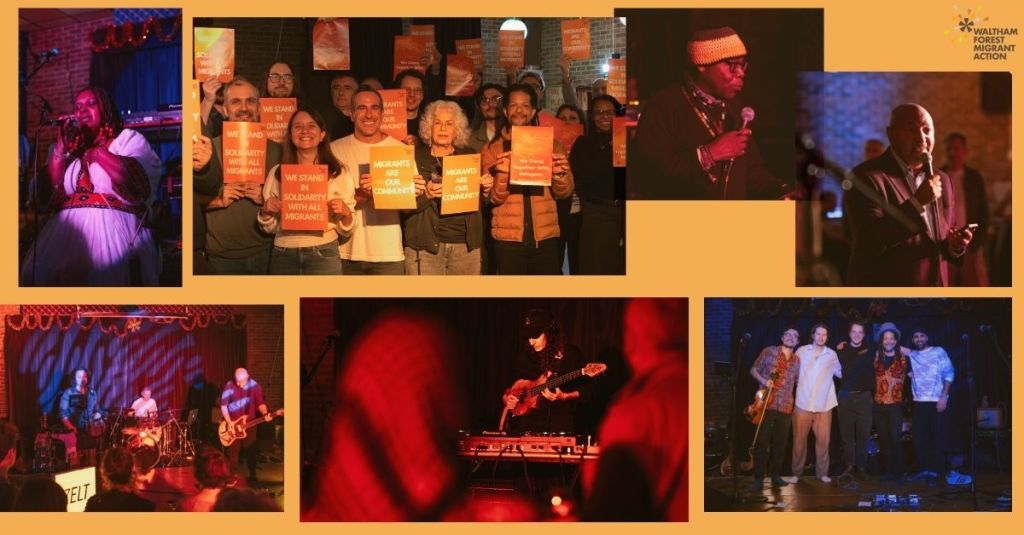
Clockwise from the top: Leensaa, WFMA solidarity action, Peter Ashan, Bekely Woyecha, Nkomba, Jana Saleh, and Zelt.
Well, that was fun!
Last week, many of us came together at the Walthamstow Trades Hall for what turned out to be an incredible event and powerful celebration of what’s best about our community.
Connections in Sound promised a lot – and delivered so much more.
We were blessed to have some very talented artists join us on the night. They shared their beautiful energy and creativity. Their music spanning different genres, influences and continents, kept crowds dancing all night.
Our dear friend Bekele Woyecha, Deputy Director of the Asylum Reform Initiative and Together With Refugees, introduced the evening, reminding us that our support for migrant justice is not optional. He announced the first singer, Leensaa Getachew, Oromo vocalist, who sang a cappella – her magnificent voice filling the hall.
Peter Ashan, WFMA’s Chair, took the stage next, inviting guests to take part in a solidarity action and welcoming artists.
Lebanese DJ and producer, Jana Saleh, was first up. She debuted her new ‘I only have eyes for you’ piece, which is launching next year, with Mais Um Discos.
ZELT, our close partners in this project, delighted the crowd with some old and new tunes, their mesmerising singer, Semra, simultaneously playing daburka.
London-based band, Nkomba, closed the event in a rousing finale, with their vibrant mix of Malawian folk and African roots.
And Lewis Robinson, from Mais Um, spun tunes throughout the evening – making it a seamless musical journey.
But that was just one part. None of this magic would have happened without the up-for-it crowd, volunteers, bar staff, friends – all of you who brought such warm buzz to night. Together we created something unique. Thank you.
WFMA update
Winter break at the Friday drop-in

Campaigning for change
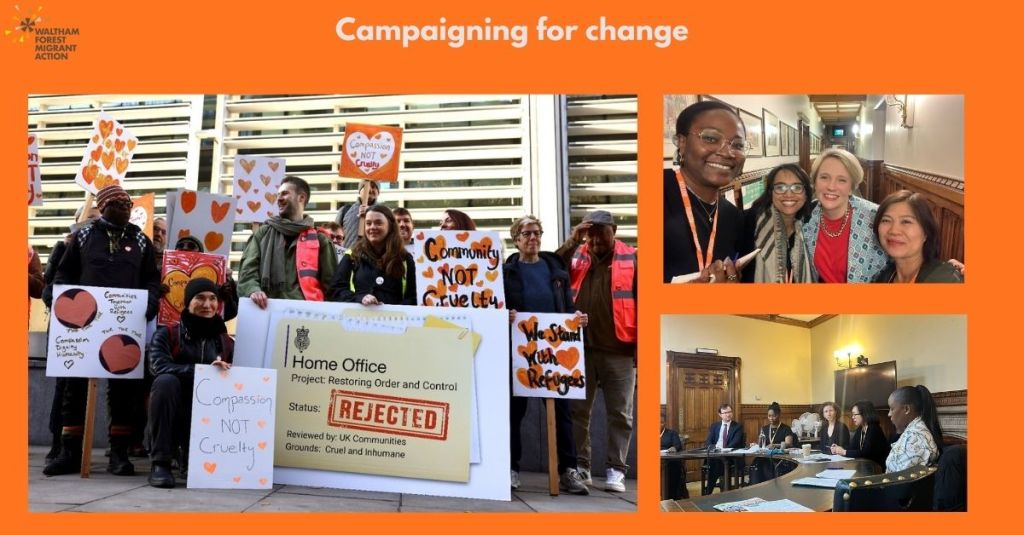
Clockwise: Together with Refugees action outside the Home Office and Citizens UK colleagues sharing evidence in Parliament.
Over the last year, we have worked with two national coalitions: Together With Refugees and Citizens UK, and in December, we were directly involved in the following initiatives.
We signed onto a Together with Refugees letter, and a few days later, on 5th December, we joined coalition members for an action outside the Home Office to reject recent policy proposals affecting people seeking sanctuary.
WFMA Chair, Peter Ashan, addressed campaigners, raising some important points:
“Waltham Forest Migrant Action has first hand experience of people on the sharp end of the asylum system. People coming to our weekly drop-in, many facing multiple challenges and feeling anxious about their immigration status, their inability to afford costly visa applications, the general lack of security and opportunity, and increasingly public animosity.
Over the years, we’ve seen how anti-migrant rhetoric has been whipped up in politics and the media. More recently, we’ve witnessed disturbing attacks targeting hotels, including in nearby Epping, housing people seeking asylum and now, a surge in co-ordinated far-right violence, rooted in racism and Islamophobia, risks dividing our communities.
The Home Secretary’s recent proposals make a mockery of human rights and basic human decency. They risk pushing people, who have fled wars, persecution, torture or climate catastrophe, into appalling situations where they face destitution, detention, or deportation.
We want a world of compassion not cruelty.”
He also reminded everyone to mark their diaries for 28th March 2026, for the national march against the far right.

We also worked with colleagues at Citizens UK Waltham Forest to call on our local MPs – Stella Creasy MP (Walthamstow), Calvin Bailey MP ( Leyton and Wanstead), and Sir Iain Duncan Smith MP (Chingford and Woodford Green), to join a Parliamentary event with Alex Norris MP, Minister for Border Security and Asylum, chaired by Anneliese Dodds MP.
Colleagues from St Barnabas Church represented Waltham Forest at the meeting and we were pleased to have support from Stella Creasy MP. We look forward to continuing engaging with her and others on these pressing issues.
London Migration Film festival
One of our new trustee, Safiyyah, recently represented WFMA at the debut of the London Migration Film Festival 2025. Behind our little information stall, she had the chance to connect with many people, sharing information about our work and hearing their own stories and questions about the reality of migration.
She attended the screening of ‘Ghost trail’ – a powerful and harrowing viewing filled with stories of displacement, loss and resilience. It captured the raw pain of a Syrian refugee trying to deal with the aftermath of unspeakable torture and forced migration.
The evening reinforced tenfold both the importance of providing safe spaces for these stories to be heard, and for the storytellers to be able to exist with dignity and belonging. Behind every policy debate and media headline, there is a person still simply trying to belong, still searching for safety and still trying to rebuild.
Migration is not just a number or statistic, it is someone’s mother, child, brother or friend. We owe it to them to listen, to continue strong in the work we do here at WFMA and to create communities where their futures are not treated as negotiable. Stories like these are not only a reminder of what people have survived, but of what we must all fight to change.
Order your poster today!
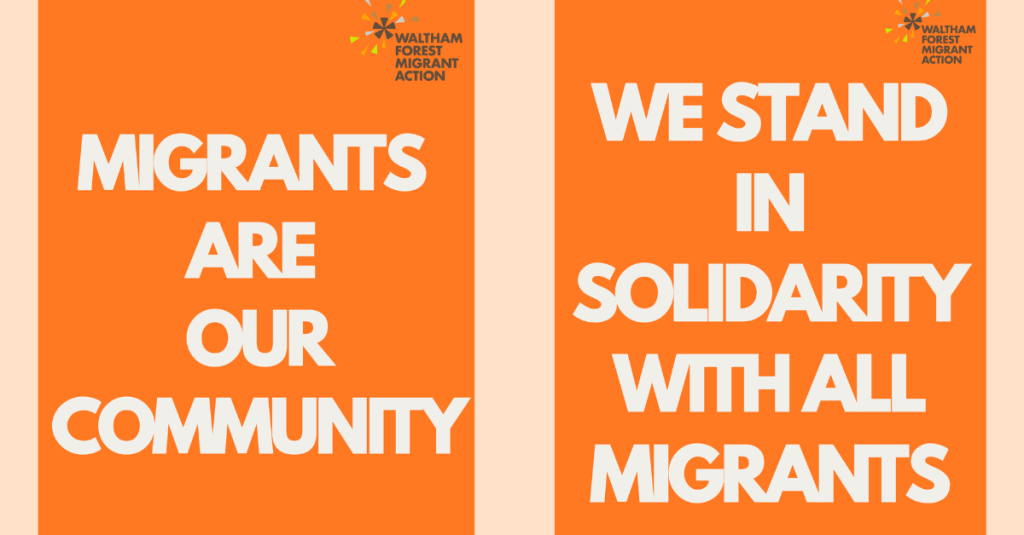
Like us, many of you have expressed dismay at the aggressive political tactics that are targeting people seeking safety. More than ever, our community must show solidarity with migrants. One of the ways you can do this is by displaying a poster at your window.
You can order posters or request the pdf for home printing by emailing [email protected], stating your preference. Please expect a seasonal delay.
Posters are free, but donations gratefully received.
In the News
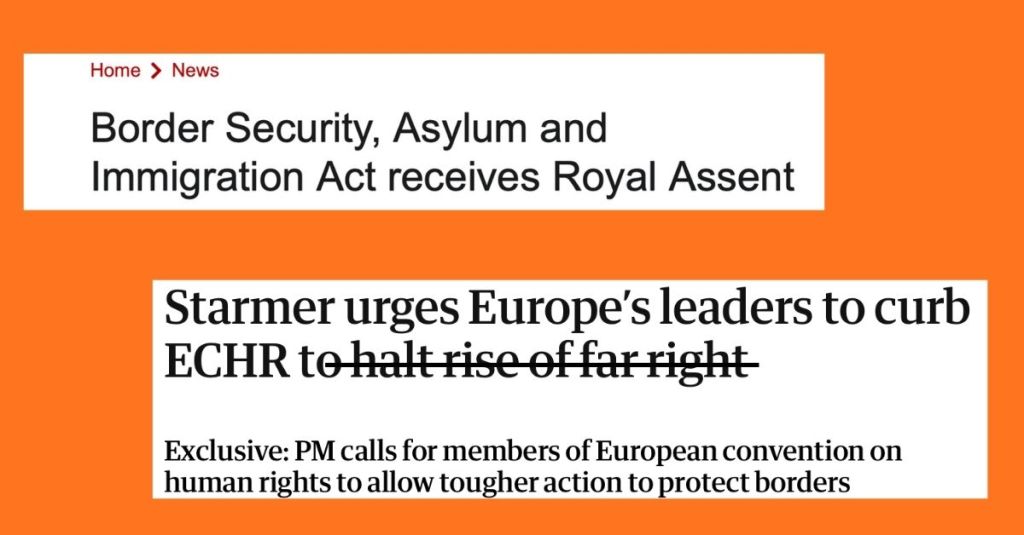
New legislation
Right to Remain provided an excellent summary of the Border Security, Asylum and Immigration Act 2025, that made it on the statute book on 02 December 2025. The latest in a long series of immigration laws: Nationality and Borders Act 2022, Illegal Migration Act 2023 and Safety of Rwanda (Asylum and Immigration) Act 2024.
Essentially, it builds on previous Acts and reinforces them. One of the changes is that the Safety of Rwanda (Asylum and Immigration) Act 2024 has been repealed, along with the many provisions of the Illegal Migration Act that were brought in to facilitate removals to Rwanda, such as mandatory inadmissibility and the duty to remove – e.g. people arriving to the UK ‘without permission’. BUT, as we have seen in recent months, under the new ‘one in – one out’ treaty with France, people arriving by Channel crossing are being ‘removed’ and sent to France.
And in case you wondered, the main reasons the Safety of Rwanda Act was so swiftly repealed are that it was impossible to implement and exorbitantly expensive. Looking for evidence, led me to this very interesting, in depth piece: Q&A from The Migration Observatory that delves into the policy itself as well as the implications that might have been.
The new Act also creates new criminal offences and powers, mainly around so-called ‘organised immigration crime’ and also gives stronger powers over phones and data. So, overall there is more control, and more personal information can be copied, stored and shared between different government bodies. In addition, the law contributes to a general shift towards more immigration enforcement and criminalisation of migration – i.e. more raids, more detentions, and more deportations.
Migrants Rights Network raise an important point from the outset about the Border Security, Asylum and Immigration Act. ‘For the first time, the counter-terror framework is being used as the primary approach to migration policy. What this means is that excessive powers are able to be brought in with regard to surveillance, pre-crime policing and sentencing’. And, of course, border surveillance is big business for companies such as US-based defence Anduril Industries.’
For more detailed information and updates about the legal context and implications, please also refer to Right to Remain, Free Movement and Migrants Rights Network.
Goodbye Human Rights
In the current context, it’s no surprise that PM Keir Starmer, and Justice Secretary David Lammy, are pushing to water down the European Convention on Human Rights (ECHR). Aligning themselves with some of the most extreme Europeans representatives including Italy, Hungary and Denmark, they called to “tighten the treaty’s interpretations. The people most affected would be those who currently rely on Article 3, covering torture or inhuman treatment, or Article 8, which protects family life, to argue against removal.”
It’s not difficult to see how it all ties up. Let’s make no mistake, curbing human rights is a race to the bottom that will harm us all – as will moves to increase surveillance. Facial recognition is now a frequent occurrence – including on our own High Street.

Having read the news section, you are no doubt ready for those ‘’tricky conversations’. And while this is themed for the season – this guide is not just for xmas. You can use it all year round!
For those who will be spending time with family and friends, this could be a time of difficult conversation. WFMA’s Festive Migration Conversation Guide will help steer you through those tricky topics and ensure the only thing you put a fork in is a roast potato, rather than your free-speech-loving uncle.
1. Understand. It’s tempting to make the case for migrants immediately, and fight misinformation with facts, but first you need to understand – or at least try to understand where the other person stands.
What are they specifically worried about? What is their overall view of migration?
Maybe there’s no point in talking – they’ve already made their mind up or harbour far-right, racist views and believe that citizens with Indefinite Leave to Remain (ILR) should be deported; in which case you might as well divert the conversation onto a new topic, as your chances of changing their mind are pretty low. Maybe, quickly move onto favourite Christmas songs?
2. Find the right message. If their views are not quite that extreme, you might be in with a chance. What’s your social capital with this person? Are they worried about crime. Are they worried about housing? Strain on the NHS? Here’s your chance to tackle a particular issue. You may have had this conversation before but go gently – it’s Christmas! And more importantly, if someone tries to police your tone, the discussion might already be over
3. Hold your ground. Don’t begin with “I admit Angela Merkel might have gone too far”, don’t agree that there are “legitimate concerns.” There aren’t any! Accepting the framing of anti-migrant voices means you are accepting their terms, and giving way weakens your point. You aren’t trying to find a midpoint between anti-migrant beliefs and pro-migrant beliefs. Being pro-migrant isn’t just for Christmas, so always be pro-migrant.
4. Make clear that migrants are ‘normal’ people. A lot of the narrative around migrants focuses on separating them from the ‘native’ population. They are not villains, they are not heroes, they are like all of us, since we are an island of migrants. Migration has always existed and always will.
5. Don’t get bogged down in obscure stats or case studies. You probably know if the person you’re talking with is acting in bad faith. If they are, see point 1! If not, they may have picked up strange stories or misunderstood ‘facts’ online. You may remember the time Theresa May talked about the person who ‘couldn’t be deported because they had a cat.‘ This was untrue. Just like Nigel Farage claiming that migrants are eating swans! It is likely whichever story your family member brings up is untrue, or at the least a highly unusual story that doesn’t represent the reality, but you don’t have the evidence they want to disprove it. So best to move on – an eye roll would be totally justified.
6. Challenge common myths. Most migrants move to the nearest country. Most migrants can’t claim benefits. Migrants pay taxes and pay a lot more to use the NHS than UK residents do. Migrants use the NHS less than non-migrants. And, of course without migrant workers both the health and social care systems would grind to a halt. You know the drill!
7. Confidently point out the positives of migration – there are so many! Migration enriches our society. What elements of migration can they connect with? The most obvious – what’s their favourite takeaway? Are all of their favourite musicians from the UK? Are their friends? That must be boring if so. You can focus on the economic benefits of migration if that seems most effective, but really, we’re talking about people, and we should be proud and confident in doing so.
8. No-one has to ‘win.’ It’s unlikely anyone will declare they are newly open minded at the Christmas table. Fighting for migrant justice is long and hard work – especially at a time when there is so much anti-migrant rhetoric. What is important is to stand up for migrants in all settings. Maybe your conversation will get other people thinking, especially if others are listening. This conversation could be one of the moments that moves someone along to a softer opinion somewhere in the future. This Christmas, it’s worth a shot.
If you found this guide useful, share it with friends and allies … or with your dreaded uncle.
 Waltham Forest Migrant Action