
CW: gender-based violence and abuse
Every year, between 25 November and 10 December women’s rights and feminist organisations and movements, around the world, mark the ’16 days of activism to end violence against women and girls’ – a vital moment to reflect and act on the urgent need to stop one of the most insidious human rights abuses in the world.
Gender based violence – in particular against women and girls – is a global crisis. No country escapes the scourge of misogyny. We’ve certainly seen abundant evidence in the UK over the past weeks alone. More on that later.
Gender-based violence occurs across all social, economic, and ethnic groups, but low-income, racialised, migrant, and displaced people – women and girls in particular – are at greater risk of violence due to overlapping inequalities, discrimination, and structural barriers.
Women and girls from migrant communities face additional institutional, legal or language barriers, as well as lack of accessibility to services, insecure immigration status and even risk of detention or deportation – all of which make reporting abuse, and accessing safety or services far more difficult.
Why gender-based violence is a migrant justice issue
Many people – particularly women and girls – fleeing conflict, displacement, or economic and climate crises have experienced some form of violence. Women for Refugee Women research shows that the majority of women seeking asylum in the UK are survivors of r*pe and other forms of gender-based violence, including domestic abuse, forced marriage, female genital cutting and s*xual exploitation.
When they arrive to the UK, their troubles are far from over.
No Recourse to Public Funds
Most people who come to the UK to visit, study or work are given a ‘No Recourse to Public Funds’ (NRPF) condition. Someone with NRPF cannot claim most benefits or access local authority housing assistance – that includes (but is not limited to): carer’s allowance, child benefit, disability living allowance, universal credit, as well as local authority homelessness assistance or social housing. According to Southall Black Sisters, NRPF is ‘one of the most significant barriers preventing migrant women from escaping abuse’.
No right to work
The lack of access to public funds is compounded by the work ban. Most people who have claimed asylum in the UK are initially not allowed to work and are forced to depend on the meagre Home Office Allowance: £49.18 per person/week for eligible people whose meals are not provided; and £9.95 per person/week if meals are provided. The limited permission to work – if an initial decision has been outstanding for more than 12 months and the delay is not the applicant’s fault – is subject to stringent restrictions published on the Immigration Salary List and excludes those who have lodged an appeal.
Such constraints have huge repercussions on individual’s ability to rebuild their lives. For survivors of abuse and violence, the consequences can be far more severe. Women for Refugee Women’s report ‘Safety and Survival: how the work ban fuels violence against women seeking asylum’ highlights how women are being forced to enter or stay in unwanted or abusive relationships, or exploitative and dangerous situations where they become more vulnerable to sexual violence.
‘Earned’ settlement
The ‘earned’ settlement proposals outlined by Shabana Mahmood earlier in November will have a significant impact on people seeking safety. Her call to extend qualifying periods for indefinite leave to remain up to a minimum of ten years that could then stretch to 30 years for people who have arrived by a route deemed ‘illegal’ is chilling.
Applicants will also be required to fulfil mandatory conditions, such as having no criminal record, no unpaid government debt, Level B2 English proficiency, and 3 years of National Insurance contributions – with a minimum salary of £12,571 – or a combined £25,142 for a couple.
These proposals will disproportionality impact women and girls. They make it harder to meet the criteria required to secure permanent status and are particularly discriminatory for women with children and survivors of gender-based violence.
For instance, women could be trapped in an unwanted or abusive relationship because they are unable to earn the minimum salary (£12,571) and could only prove national insurance contributions if they stay in an abusive relationship.
Left behind
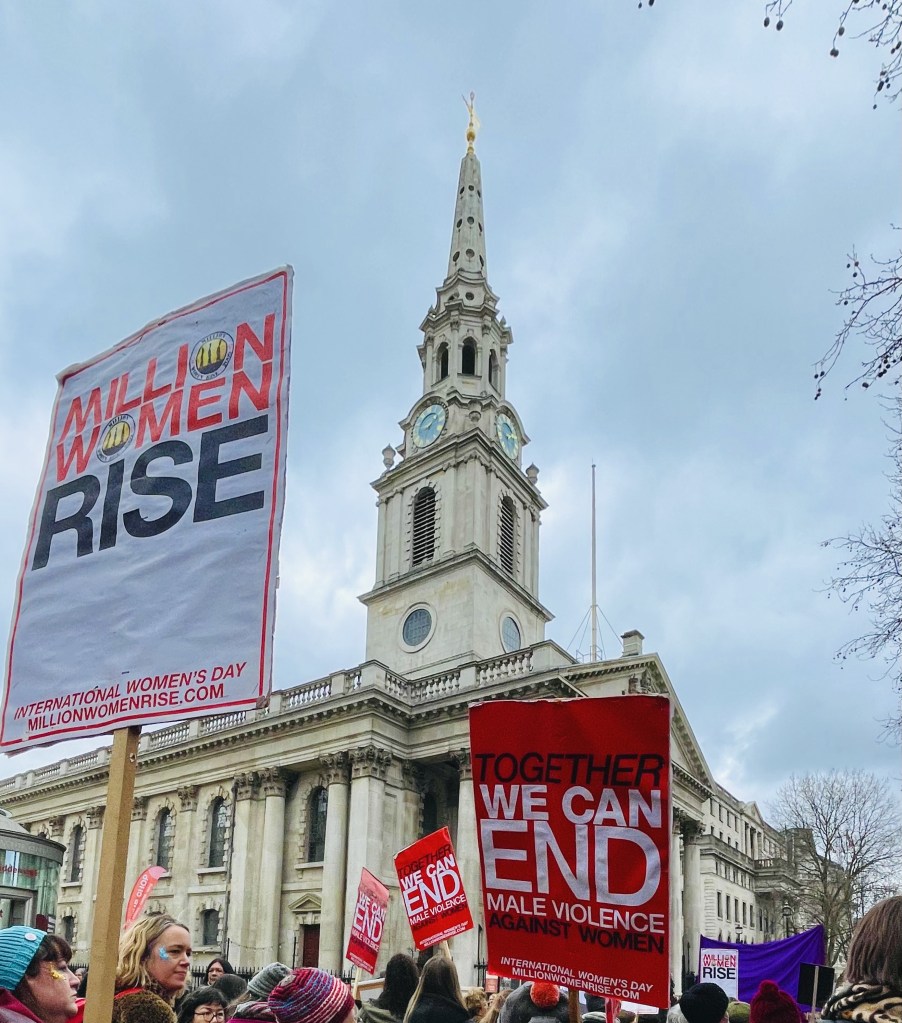
The UK government’s immigration policy not only perpetuates and exacerbates violence against migrant women and girls, it flies in the face of its so-called ‘commitment to the rights of women and girls around the world‘ and its own strategy to halve the incidence of domestic abuse.
Last September, the Home Office chose to indefinitely pause the family reunion route. The latest Refugee Council figures reveal that from April to June 2026, over 20,000 people may have been prevented from applying for refugee family reunion, including 18,633 women and children.
Access to specialist services
Immigration policy puts migrant women who have suffered domestic abuse and are financially or otherwise dependent on their spouse or partner at greater risk. For those with NRPF, access to refuge spaces is extremely limited if not impossible. Most services rely on housing benefit to cover their operational costs, shutting women with NRPF out.
As part of their Nowhere to Turn Project, Women’s Aid emphasised that refuge provision is under huge strain – 65.2% of referrals for a bed space into refuge are rejected. For migrant women with NRPF the picture is even bleaker. In 2024 – 2025, only 11.5% of vacancies listed on ‘Route to Support’ could consider a woman with NRPF, a situation that is further exacerbated by the shortage of specialist ‘by and for’ Black and minoritised services, due to chronic underfunding.
This is just a glimpse of the compounding challenges migrant survivors of abuse face in the UK, and does not account for the emotional, psychological and physical toll of gender-based violence on individuals, families and communities.
Immigration policy and the far right
Anti-migrant rhetoric has been very successful in driving an ever more draconian hostile environment and is directly mirrored in Home Office policy and government legislation.
In summer 2025, racist violence erupted outside the Bell Hotel in Epping – supposedly sparked by the arrest of a man housed at the hotel, following accusations of s*xual assault – for which he received a 12 months prison sentence. People, mostly men, who had never expressed the slightest interest in challenging patriarchal power, took to the streets to ‘Save Our Kids’ and ‘Protect Our Women’.
Where were they during the Russell Brand trial?
Similar violent, far-right riots had erupted in Southport in 2024, following a tragic incident that cost three girls their lives. It was then reported that one in five people arrested during the 2024 anti-migrant riots have since been reported to police for domestic abuse.
This hasn’t stopped the right and the far-right from weaponising violence against women and girls for political gain. Reform UK used their platform to fan the flames. They published their ‘Operation Restoring Justice’ policy document, which they framed as an attempt to prioritise ‘safety for women and girls’. Meanwhile, Robert Jenrick MP, then Conservative Shadow Justice Secretary, now Reform UK’s Chancellor, chose to attend the Epping ‘rally’ in summer 2025, stoking up fear about his daughters’ safety – at risk he said from ‘foreign criminals’.
Not wanting to be left out, the government promptly set to work with their guide to ‘Understanding behaviours and expectations in the UK: a guide for Asylum seekers’. In addition to being inherently racist, the publication ignores a very important fact: misogyny and gender-based violence know no borders!
We only need to cast our memories back a few weeks when Russell Brand was found guilty of multiple incidents of s*xual assault and r*pe that will see him spend ten years and six months in prison. And let’s not forget how his behaviour was openly condoned in the public domain for years. Nigel Farage even appeared on Brand’s podcast after the investigation began.
Solidarity with ALL women and girls
None of Us Are Free Until All of Us Are Free, Audre Lorde
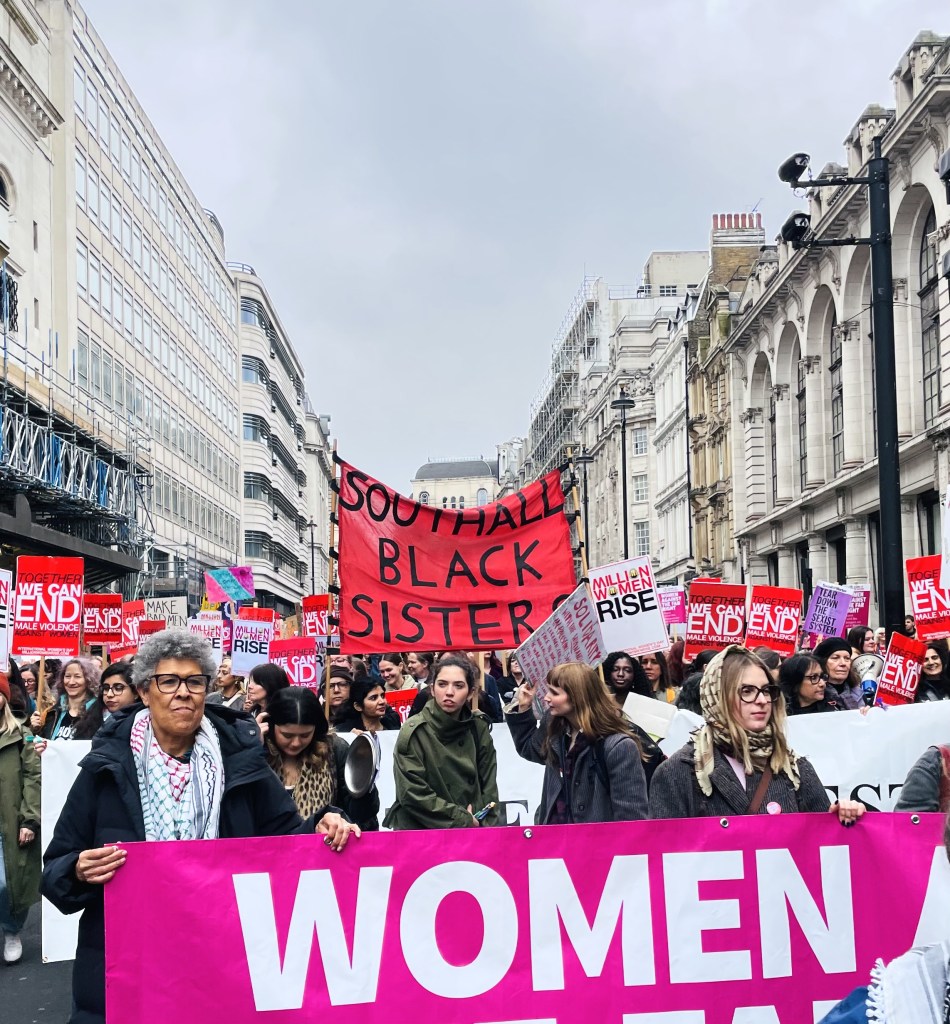
In the sea of darkness that is immigration policy, it’s not easy to dig out good news. But here it is – the glimmer of hope. A positive change to immigration rules was announced in early October to allow more survivors of domestic abuse in the UK to apply for Indefinite Leave to Remain, thus providing a broader route to safety and stability for people living in abusive situations. Read Right to Remain’s blog post and Asylum Support Appeals Project’s factsheet to understand the Home Office guidance regarding asylum-seeker who experience domestic abuse in the UK and need safe housing and support.
Such minor shifts can seem futile but they have an incremental impact and show just how important it is for all of us to continue pushing for change together. We are grateful to UK feminist and women’s rights organisations and movements for being at the forefront of challenging the government policy and anti-migrant rhetoric, and speaking out for migrant survivors at the sharp end of the hostile environment.
WFMA advisers often speak to survivors of gender-based violence at our weekly drop in and know first hand the precarity of their situation.
S. is a survivor of domestic abuse with NRPF. She has two young children and was homeless and staying in a hotel. We were able to support and refer her to the British Red Cross, Gender-based Violence Project. In an email she sent us, she reflects:
“It was such a difficult time, I didn’t know where to turn. I was accepted for support from Migrant Help, and E. was absolutely amazing. She cared so much, followed up on everything, and has shown me so much kindness and care. I honestly can’t find the words to express how grateful I am for your support. I will always remember your kindness.”
If you or anyone you know is impacted by any form of gender-based violence, you can contact the organisations below for support:
Latin American Women’s Rights Service provide confidential specialist services for all Latin American women, including advice and counselling for women facing gender violence, legal advice in welfare benefits, housing and employment rights. Helpline: 0808 145 4909 (Tuesday to Friday, 11.00 am to 1.00 pm).
Refuge (supporting survivors with emergency accommodation, legal support) manage the national domestic abuse helpline: 0808 2000 247
Rights of Women:
- Family Law: 020 7251 6577
- Criminal Law: 020 7251 8887
- For Women in London: 020 7608 1137
- Immigration & Asylum: 020 7490 7689
Southall Black Sisters – specialist services black and minoritised women in the UK. Helpline: 0208 571 0800 (Monday to Thursday from 10.00am to 4.00pm).
More specialist services can be found in the EVAW coalition members’ list.
If you are a migrant survivor of abuse living in Waltham Forest and need advice or signposting, please visit our weekly drop in on Friday 10.00 am to 12.30 pm.

